Most of my work on void statistics was published (arXiv:2403.15134), though some extensions are only in my thesis. Here, I explain a few parts at a slightly less technical level.
What is a void?
Gravity causes matter to cluster together into galaxies. Galaxies themselves also organise under the influence of gravity, forming galaxy clusters, which themselves form into filaments and sheets of clusters, called the cosmic web. The space between, containing no galaxies (or very few), is the cosmic void.
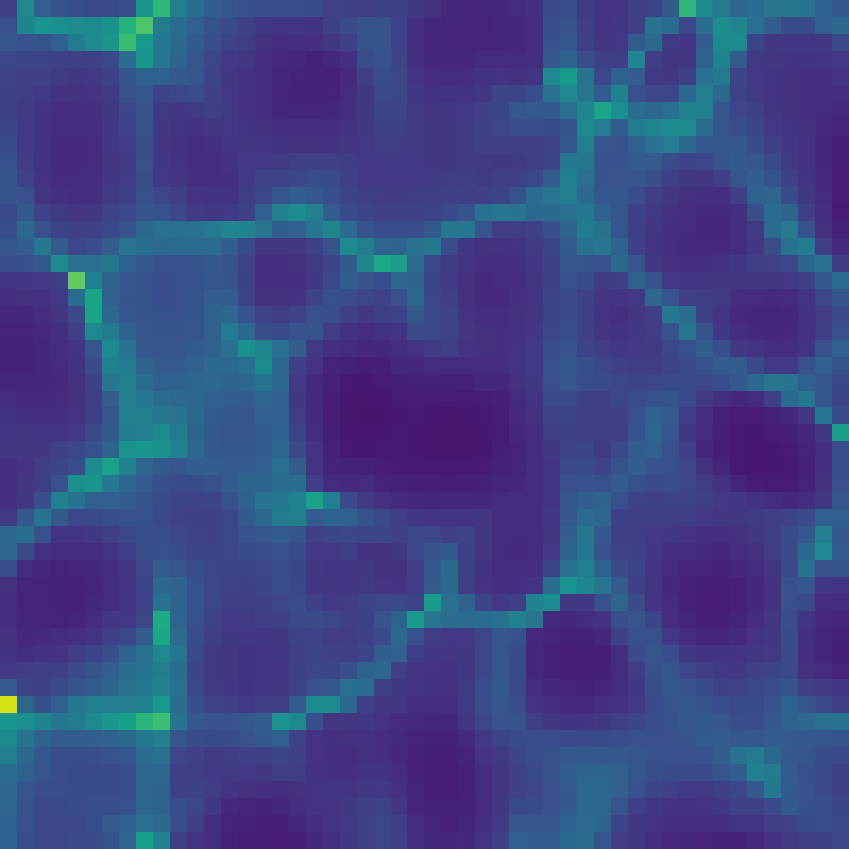
For a two-dimensional analogue, consider a honeycomb. The comb itself is where the galaxies reside, while the pockets in the comb are the voids. In three dimensions, imagine a large pile of bubbles like dishsoap in a sink. If you look closely at the bubbles, two adjacent bubbles share a wall of liquid film. While isolated bubbles are round, a shared wall between two bubbles is stretched flat. Where three bubbles meet, there is a straight line on the edge they share (they look like a three-dimensional Voronoi diagram, if that means anything). In the cosmic web, galaxies live on the liquid film which makes up the bubbles, while the air within the bubbles corresponds to a cosmic void. It is important to remember that the bubbles are not isolated, but are always surrounded by other bubbles which share a wall; every part of the universe is either inside a bubble (a cosmic void) or in the film (the walls).
Unlike bubbles, which are necessarily convex because of the tension in the film, cosmic voids are generally not convex and can be far from spherical. While the walls of a bubble are well-defined and the transition from the liquid film to the air inside is clear, this is not the case for cosmic voids. Almost all of each wall is empty space, as individual galaxies are very small compared to the scale of the cosmic web.
How do we find them?
The data we have to work with consists of a 3D grid of floating-point values representing the density of matter in a particular cell. The approach changes a little in observational data, where one only has galaxy positions, but in general these positions are just used to estimate a 3D density field anyway. From this, we hope to categorise each individual cell as being part of a void or wall, and to identify which groups of cells are part of the same void.
We use a technique from image processing, the watershed transform.
This part of the post is unfinished. I'll write some more on it later, hopefully, but the details are in the paper and thesis.